Welcome to Octopus Moving Company | Massachusetts, Rhode Island, North Carolina
Welcome to Octopus Moving Company | Massachusetts, Rhode Island, North Carolina

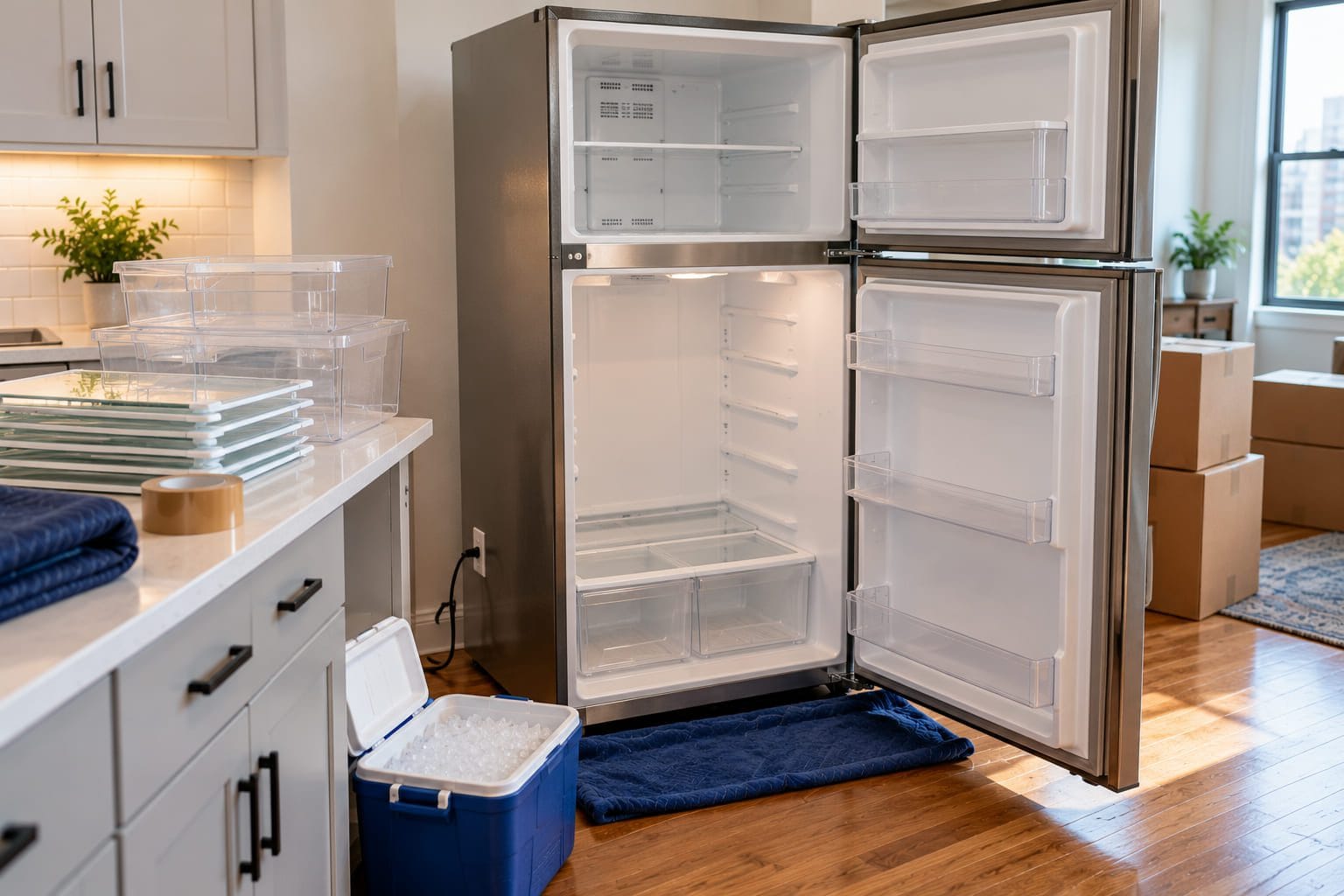
A refrigerator is the one appliance that can work fine on moving morning and refuse to cool that night, usually because it was laid on its back or plugged in too soon. This guide covers how to move a fridge from start to finish: what to do the day before, how to get it onto a dolly and into the truck, when it’s allowed to lie down, and how long to wait before you turn it back on. It comes from Octopus Moving, a licensed and insured mover with full-time crews in Massachusetts, Rhode Island, North Carolina and Illinois, and it follows the manufacturers’ own moving instructions.
Most fridge damage happens because the prep got squeezed into the last hour. Build it into your plan alongside everything else; our guide on when to start packing for a move suggests leaving big appliances and furniture to the movers while you focus on the boxes, and the fridge is the clearest case.
Start with the food. According to FoodSafety.gov’s power outage guidance, a refrigerator keeps food safe for up to 4 hours without power if the door stays shut, and a cooler needs enough ice to hold food at 40°F or below. A fridge in a truck is a fridge without power, so eat down the perishables in the last week and pack the rest in coolers.
Then prep the appliance itself:
If you’re not sure who handles the water line, ask when you book so nobody finds out with the crew standing in the kitchen.
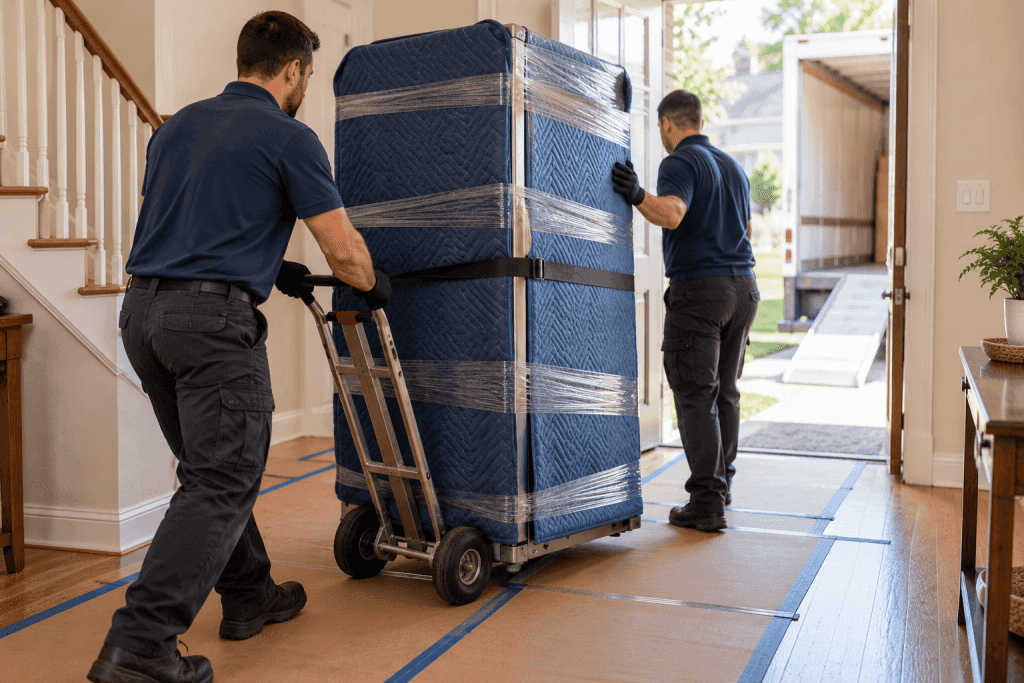
The safe way to transport a refrigerator is upright, on an appliance dolly, strapped in place. GE’s refrigerator moving instructions say to load the dolly from the side only, and to strap the unit so it can’t shift in the vehicle. Loading from the front or back puts the dolly’s weight on the doors or the compressor area.
Wrap the exterior before it leaves the kitchen. Octopus crews bring moving blankets on every job, the material our packing services and supplies page lists as the best choice for appliance safety, and shrink wrap keeps the blankets and doors in place. In Boston, where a lot of moves are third-floor walk-ups with tight stair turns, the fridge is the piece that needs the most planning.
You can move a fridge without a dolly across a single room, and not much farther. Rock it side to side to walk it forward, or tilt it back slightly and slide furniture sliders or a piece of hardboard under the feet. That’s enough to clean behind it or swap kitchens in the same home. For stairs, a truck, or anything past the front door, Whirlpool’s guide to moving a refrigerator is plain: a fridge shouldn’t move without a dolly except to pull it out of its cutout.
Keep it upright whenever you can. When a fridge lies down, compressor oil can run into the cooling lines, and starting it before that oil drains back is how compressors fail. If it truly won’t fit standing up, the rules depend on the model. Here’s what GE’s instructions allow:
| Refrigerator type | If it must lie down |
| Top-freezer | On the side opposite the door hinges |
| Side-by-side | On the freezer side |
| French-door and bottom-freezer | Keep upright; tilting only to clear doorways |
| Compact | Keep upright; if it must go on its side, turn it off a day ahead and let it drain |
| Built-in | Always upright in the vehicle |
Never lay any fridge on its front or back. Whirlpool is just as clear that only the left or right side is acceptable. Brands differ on the details, so check your owner’s manual before you load it.
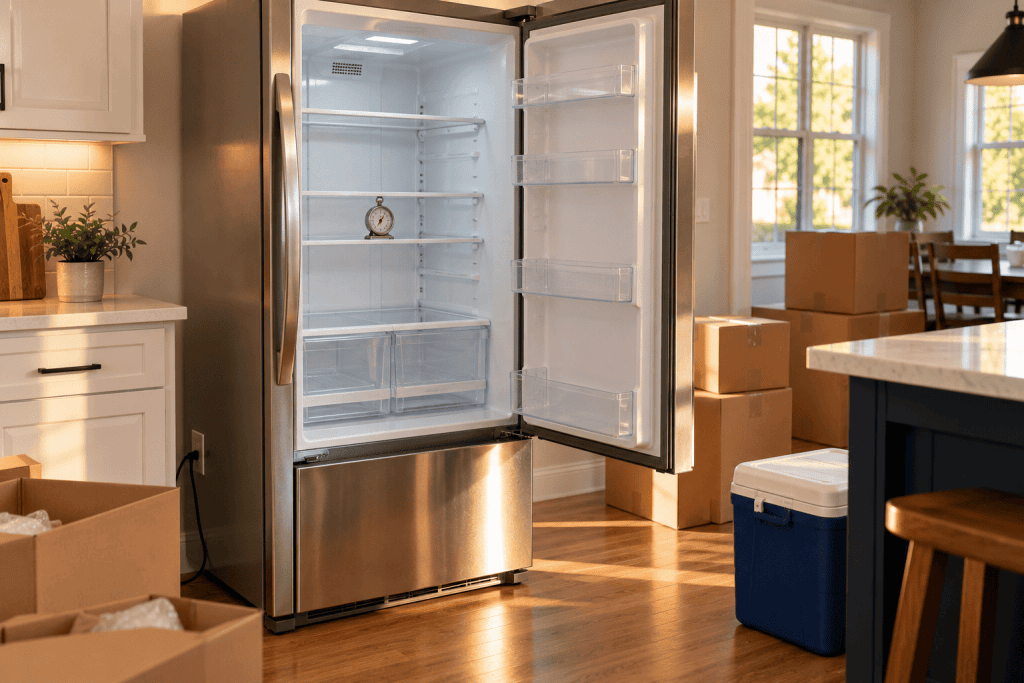
Getting the fridge into the new kitchen is half the job. The restart is where impatience costs money.
Moved upright the whole way? Neither GE’s nor Whirlpool’s instructions set a wait for that case, so check the owner’s manual for your model.
Sometimes the old fridge stays behind until the new kitchen is ready. Temperature-controlled moving and storage from Octopus starts at $75 a month for a room or less, with a one-month minimum, and the crew handles pickup and delivery. Store the fridge clean, dry and upright, and prop the doors open a few inches so it doesn’t trap moisture and smell while it sits.
Turn the fridge off the day before you move. GE says a frost-free model needs only a couple of hours for the evaporator to defrost, but unplugging it the night before gives you time to empty it, catch the meltwater, and dry the inside. A manual-defrost freezer with heavy ice buildup needs the full night.
Pack the food into coolers before you unplug it, not after.
Two people can move a fridge, but they shouldn’t carry it. The safe method is to tilt it onto an appliance dolly from the side, strap it on, and roll it, with one person on the handle and one guiding. Lifting a full-size refrigerator by hand, especially on stairs, risks injuries, dropped units and damaged walls.
If the route includes a walk-up or tight turns, that’s the point where a professional crew earns its rate.
Protect the floor before the fridge moves at all. Lay hardboard, cardboard or floor runners along the path, put furniture sliders under the feet to walk it out of the cutout, and roll it on a dolly from there instead of dragging it. Most scratches happen in the first two feet, while it’s pulled out.
Octopus moves include blankets and floor protection in the hourly rate.
On a local Octopus Moving job, the fridge is part of the hourly move rather than a separate fee. Two movers and a 20-foot truck start at $139 an hour, with blankets, floor protection, gas and tolls included. A fridge adds time mainly through stairs, tight doorways and water-line disconnection, so mention those when you book.
Three-mover crews start at $209 an hour and four-mover crews at $279.
Yes, if it rides upright. Stand the fridge against the front of the bed behind the cab, strap it to the tie-down points on both sides, and drive slowly with no hard stops. Laying it flat in the bed to clear a low garage or bridge is the move that damages compressors, so measure the height first.
Bring a second person and an appliance dolly; the tailgate is the hardest part of the trip.
The decision now is whether the fridge is a job for you and a friend with a rented dolly, or one to hand off with the rest of the move. A ground-floor kitchen and a pickup truck can work. Stairs, a tight doorway or a long-distance trip usually tip it the other way, and every Octopus mover is a full-time employee, not a day laborer. Call (781) 333-5383 or get a quote for your move in Massachusetts, Rhode Island, North Carolina or Illinois.